Mender blog

Today, Mender officially releases support for microcontrollers (MCUs). Mender for Microcontrollers is generally available, complete with a purpose-built setup for resource-constrained devices, the new Micro Device Tier.
Previewing Mender on ESP32 with Zephyr for about a year allowed the Mender team to engage with the community and gather early test feedback. The response was overwhelmingly clear: the demand for reliable, managed over-the-air (OTA) updates on microcontrollers is real — and engineers building on Zephyr want Mender to be part of their strategy.
Start using Mender for Microcontrollers on Zephyr today
A new Microcontroller Get Started guide is available directly in the Mender UI. Sign up, select “Learn how to connect a microcontroller device,” and walk through the setup process seamlessly. The Get Started guide provides a configuration snippet pre-populated with your actual Tenant Token and server address.
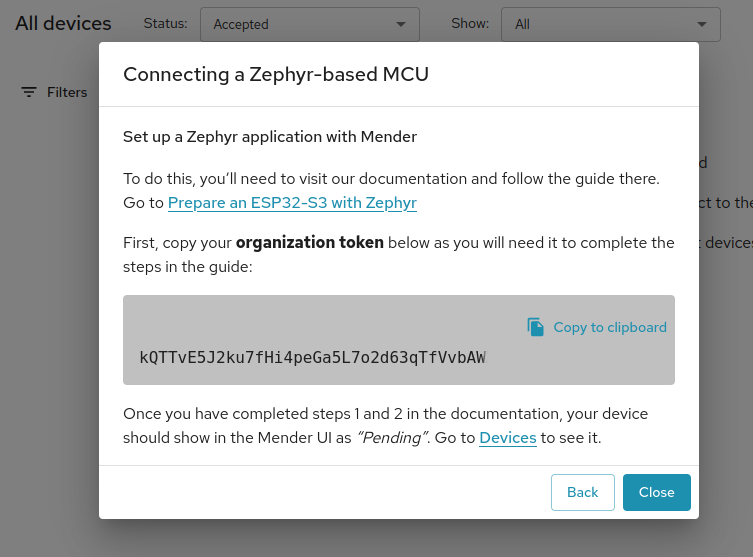
The reference hardware for the Get Started guide is the ESP32-S3. However, the Mender MCU Client works across Zephyr-supported MCUs, regardless of board type. The Device Tier is set automatically in the Zephyr build configuration by default.
Advanced Mender MCU Client and Zephyr configurations: For custom update modules, build options, and more, see the Mender Zephyr documentation.
Managing microcontroller updates in Mender
With the microcontroller release, Mender now has two Device Tiers: Micro, the new tier, and Standard, the existing tier.
The tier a device belongs to is determined on the device side and communicated to the Mender server during device authentication. The Mender server knows what type of device it is talking to from the moment a device connects. There's nothing to configure manually in the dashboard!
Micro and Standard devices are managed in the same Mender tenant, with no separate account or server required. Mixed fleets, such as Linux devices alongside MCUs, are fully supported. All core OTA update features work identically across both tiers, including inventory, filtering, device groups, and deployment reporting. Core OTA update features are set up and function the same, regardless of the type of device being updated.
What's different about microcontroller updates in Mender
Zephyr-based microcontrollers and embedded Linux devices are both "IoT devices" in the broadest sense. Apart from sharing a generic name, the two device types have almost nothing else in common from an OTA update perspective.
A microcontroller (MCU), like the ESP32-S3, runs a real-time operating system (RTOS) with kilobytes of RAM, produces firmware images measured in hundreds of kilobytes, and may live in a remote or battery-powered environment where network communication is expensive. Microcontrollers don't need — and often can't support — the same update cadence or payload sizes as a Linux device or industrial computer.
In comparing the two reference devices available in the Mender Get Started guide, the differences are clear.
|
ESP32-S3 (Micro reference device) |
Raspberry Pi 5 (Standard reference device) |
|
|
OS |
Zephyr RTOS |
Linux (e.g., Yocto) |
|
RAM |
512 KB |
4 - 8 GB |
|
Storage |
8 - 16 MB (flash) |
8 - 32 GB (SD card) |
|
Typical update size |
0.5 - 2 MB |
50 - 500 MB |
|
Update frequency |
Weekly to monthly |
Daily to weekly |
Technical differences: Microcontroller updates in Mender
The Micro Device Tier differs from Standard devices, such as Linux, in three technical ways. All technical differences are deliberate and reflect the realities of microcontroller deployments. Similarly, while both Standard and Micro Device Tiers are priced per device, the Micro Device Tier is also half the price of the Standard Device Tier.
|
Device Tier |
Micro |
Standard |
|
Maximum Artifact size |
5 MB |
10 GB |
|
Polling interval |
1 week updates 1 week inventory |
30-minute updates 8-hour inventory |
|
Mender Add-ons |
Not available |
Available |
Artifact size: A 5 MB maximum for microcontrollers
Microcontroller (MCU) firmware images are typically well below 5 MB. A 5-MB maximum Artifact size allows for updates beyond the typical range while accounting for microcontroller output and update mechanisms design.
The Mender MCU Client build toolchain checks the Artifact size at build time. If the Artifact exceeds 5 MB, Mender will display a warning during the build process and before anything reaches the Mender server. If a Micro device is somehow targeted in a deployment with an oversized Artifact, it will appear as Skipped in the deployment report — an analogous response to an incompatible device type. Skipping the device ensures the microcontroller device is never left in an inconsistent state.
Polling frequency: One week maximum for microcontrollers
All commercial plans allow microcontroller devices to check in with the Mender Server for updates and inventory once per week. Deployments are identified in each weekly check-in, so devices remain fully managed.
Microcontrollers and less complex devices typically operate in constrained environments once in the field, such as relying on cellular connections or operating on battery power; more frequent polling in these environments often increases costs, such as network usage. As such, more frequent polling intervals are impractical and, if implemented, would result in wasted resources.
Note: Free Trial accounts retain relaxed polling intervals regardless of Device Tier. Relaxed polling intervals during the Mender evaluation period allow for quick iteration and testing.
Mender Add-ons: Not available for microcontrollers
The Mender add-ons — Troubleshoot, Configure, and Monitor — are built around richer Linux environments. For most MCU use cases today, the Mender add-ons aren’t applicable and thus aren't available in this release. Mender add-on support for microcontrollers could be a future development, depending on future microcontroller developments.
Adding microcontrollers to your Mender plan
Device Tiers are independent of the plan type. Whether a Free Trial, Basic, Professional, or Enterprise plan, Micro devices, Standard devices, or both can be added in the same tenant.
Both Standard and Micro devices are charged per device. The per-device cost of Micro devices is approximately half of that of Standard devices.
For new Mender Free Trial users, the free trial account includes 5 micro devices and 5 standard devices by default. Existing Free Trial accounts are unchanged, but MCU devices can be added to them as well (up to the combined 10 device limit there).
When purchasing a new plan, choose how many devices to allocate to each Device Tier.
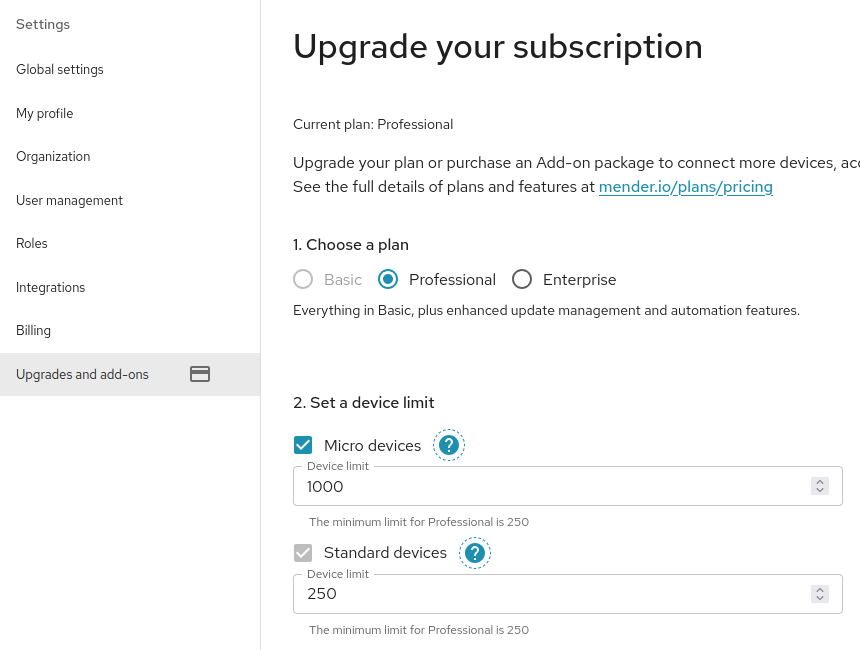
Current hosted Mender customers can add Micro devices to their existing accounts.
For hosted Mender customers with fewer than 2,000 devices and paying by credit card, adding Micro devices is fully self-service. Set your Micro device limit in the subscription portal, and the change takes effect immediately.
For hosted Mender customers with custom plans, please contact your account manager.
Note: Microcontrollers and the Micro Device Tier are currently only available for hosted Mender plans. Microcontrollers and the Micro Device Tier support for on-premise Mender Enterprise plans will be available in a future release.
Get started today
Sign up for a Free Trial and follow the Get Started for Microcontrollers guide. No paid plan is required to try it — Micro tier devices are available on Free Trial accounts.
Already have a paid Mender plan and want to add MCU devices? Add a Micro device limit directly through the self-service portal, or contact us for deployments of 2000 or more devices.
Recent articles

Software update challenges: Top scenarios to avoid (Part 1)
Explore common challenges in OTA software updates for IoT devices and learn scenarios to avoid for efficient deployment and operational success.

Kubernetes shrank for edge devices. But fleet management didn't come with it
Explore the challenges of managing K3s fleets at the edge and discover how effective fleet management can enhance Kubernetes deployments for IoT devices.

From monolithic bundles to modular intelligence: How independent update domains accelerate innovation
Discover how independent update domains in AI-enabled IoT products enhance innovation and streamline software updates for diverse applications.
Learn why leading companies choose Mender
Discover how Mender empowers both you and your customers with secure and reliable over-the-air updates for IoT devices. Focus on your product, and benefit from specialized OTA expertise and best practices.